What Is Ovulation?
Symptoms, Timing and Fertile Window Explained
Introduction
Ovulation is one of the most important parts of the menstrual cycle, especially for women who are trying to understand their fertile days, plan a pregnancy, or simply know their body better.
In simple terms, ovulation is when a mature egg is released from one of the ovaries. Once released, the egg travels into the fallopian tube, where it may meet sperm and get fertilised. If fertilisation happens, pregnancy may occur. If it does not, the egg breaks down and the menstrual cycle continues.
For many women, ovulation happens around the middle of the menstrual cycle. But it is not the same for everyone. Cycle length, hormonal changes, stress, lifestyle, illness, PCOS, thyroid concerns and other factors can affect when ovulation happens.
Understanding ovulation can make it easier to identify the fertile window, track cycle changes, and know when it may be time to speak to a doctor.
Why understanding ovulation matters
Ovulation is closely connected to fertility. Globally, around 1 in 6 people of reproductive age experience infertility at some point in their lifetime. [1] One of the reasons some women may find it difficult to conceive is irregular or absent ovulation.
Cycle irregularity is also fairly common. Around 14% to 25% of women experience irregular menstrual cycles, which may include cycles that are shorter, longer, heavier, lighter, or unpredictable. [2]
PCOS is another important factor because it can affect ovulation and may make conception more difficult for some women. Women trying to understand PCOS and fertility may benefit from learning how irregular ovulation, hormonal imbalance and lifestyle changes can influence pregnancy planning. [3]
These numbers do not mean that every delayed period or cycle change is serious. But they do show why understanding ovulation is useful, especially when periods are irregular or pregnancy planning becomes difficult.
What is ovulation?
Ovulation is the process in which one ovary releases a mature egg. This usually happens once in a menstrual cycle.
After the egg is released, it moves into the fallopian tube. If sperm are present during this time, fertilisation may happen. If the egg is not fertilised, it survives only for a short time and then breaks down. The body then moves towards the next phase of the menstrual cycle.
The egg can usually be fertilised for about 12 to 24 hours after ovulation. [4]
When does ovulation happen?
The timing of ovulation depends on the length of the menstrual cycle.
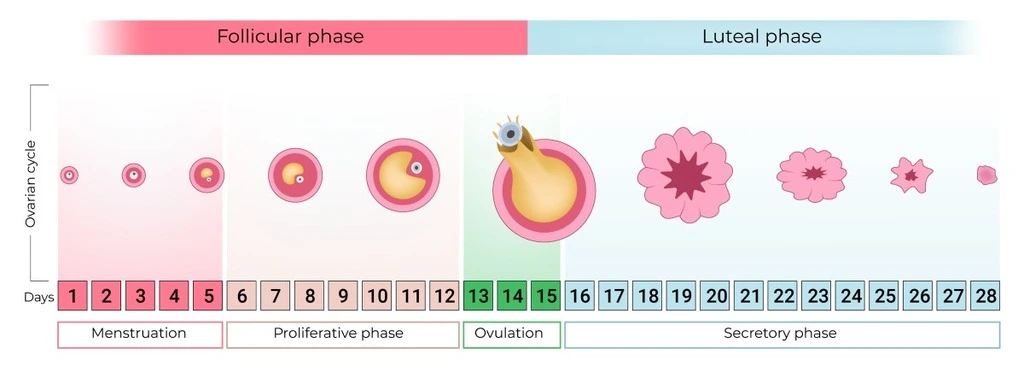
In a 28-day cycle, ovulation often happens around day 14. However, not every woman has a 28-day cycle. Some women have shorter cycles, some have longer cycles, and some have cycles that vary from month to month.
A helpful way to understand ovulation timing is this:
Ovulation usually happens around 10 to 16 days before the next period starts. [5]
So, women with shorter cycles may ovulate earlier, while women with longer cycles may ovulate later.
Estimated ovulation day by cycle length
| Menstrual cycle length | Estimated ovulation day |
|---|---|
| 24-day cycle | Around day 10 |
| 26-day cycle | Around day 12 |
| 28-day cycle | Around day 14 |
| 30-day cycle | Around day 16 |
| 32-day cycle | Around day 18 |
| 35-day cycle | Around day 21 |
Note: Day 1 is the first day of menstrual bleeding. These are only estimates. Ovulation can vary from one cycle to another, especially if periods are irregular.
What happens before ovulation?
The first part of the menstrual cycle is called the follicular phase. It starts on the first day of the period and continues until ovulation.
During this phase, the body prepares an egg for release. A hormone called follicle-stimulating hormone, or FSH, helps small fluid-filled sacs in the ovaries grow. These sacs are called follicles, and each follicle contains an immature egg.
Usually, one follicle becomes dominant. As it grows, it produces estrogen. Estrogen helps thicken the lining of the uterus so that it is ready in case pregnancy occurs.
As the follicle matures, the body moves closer to ovulation.
What happens during ovulation?
Around the time of ovulation, there is a rise in luteinising hormone, also called LH. This is known as the LH surge.
The LH surge triggers the mature follicle to rupture and release the egg from the ovary. The egg then enters the fallopian tube.
If sperm are present in the reproductive tract around this time, fertilisation may happen. If the egg is not fertilised within about 12 to 24 hours, it is no longer viable. [4]
What is the fertile window?
The fertile window is the time in the menstrual cycle when pregnancy is most likely.
It includes the few days before ovulation and the day of ovulation. This is because sperm can survive inside the female reproductive tract for about 3 to 5 days, while the egg survives for only about 12 to 24 hours after release. [4]
For example, if ovulation happens around day 14, the fertile window may fall around days 10 to 14. But this is only an estimate. The actual fertile window can shift depending on when ovulation happens in that cycle.
For women trying to conceive, timing intercourse during the fertile window may improve the chances of pregnancy. For women trying to avoid pregnancy, relying only on estimated ovulation days may not be enough, especially if cycles are irregular. A doctor can guide on more reliable contraception options.
What are the signs of ovulation?
Some women notice clear changes around ovulation. Others may not notice anything specific. Both are normal.
Common signs of ovulation may include:
| Sign | What it may suggest |
|---|---|
| Clear, slippery cervical mucus | Ovulation may be approaching |
| Mild rise in basal body temperature | Ovulation may have already happened |
| Positive ovulation predictor kit | LH surge has been detected |
| Mild pelvic pain or cramps | Some women feel one-sided ovulation pain |
| Breast tenderness | Hormonal changes around ovulation |
| Bloating | Hormonal changes during the cycle |
| Light spotting | May occur in some women around ovulation |
These signs can vary from cycle to cycle. They are useful for awareness, but they may not confirm ovulation with complete accuracy.
Cervical mucus changes during ovulation
One of the easier signs to observe is a change in cervical mucus.
Before ovulation, cervical mucus may become clear, slippery and stretchy. It is often compared to raw egg white. This type of mucus helps sperm move more easily through the reproductive tract.
After ovulation, the discharge may become thicker or reduce in quantity.
However, vaginal discharge can also change because of infections, medications, sexual activity or hormonal changes. If the discharge has a foul smell, causes itching, or is linked with pain or burning, it is better to consult a doctor.
Basal body temperature and ovulation
Basal body temperature, or BBT, is the body's temperature at complete rest.
In many women, BBT rises slightly after ovulation and remains higher until the next period. The most fertile days are usually the 2 to 3 days before this temperature rise. [6]
This means BBT is more useful for understanding ovulation patterns over time. It may confirm that ovulation has happened, but it may not always help predict ovulation in the same cycle.
For better accuracy, BBT should be checked every morning before getting out of bed, preferably at the same time each day.
LH surge and ovulation predictor kits
Ovulation predictor kits are home tests that detect a rise in luteinising hormone, or LH, in urine.
A positive test usually means ovulation may happen soon. These kits may be helpful for women with regular cycles who are trying to identify their fertile days.
However, results may be harder to interpret in women with PCOS, irregular cycles or hormonal imbalance. In such cases, a positive LH test may not always mean that ovulation will definitely happen.
How to track ovulation
There are different ways to track ovulation. No method is perfect, but using more than one method may give a better understanding of the cycle.
| Method | What it tracks | Useful for | Limitation |
|---|---|---|---|
| Calendar method | Cycle length and estimated ovulation day | Women with regular cycles | Less accurate for irregular cycles |
| Cervical mucus tracking | Changes in vaginal discharge | Identifying fertile days naturally | Needs daily observation |
| Basal body temperature | Temperature rise after ovulation | Understanding cycle pattern | Confirms ovulation after it happens |
| Ovulation predictor kit | LH surge | Predicting ovulation | May be confusing in PCOS or irregular cycles |
| Period tracking apps | Cycle dates and patterns | General cycle awareness | Predictions may not be accurate for everyone |
For women with regular cycles, these methods may help identify fertile days. For women with irregular periods, they may be less reliable and medical guidance may be useful.
Can ovulation be irregular?
Yes. Ovulation can happen earlier, later, or sometimes not happen in a particular cycle.
Irregular ovulation may be linked to:
- PCOS
- Thyroid disorders
- High stress levels
- Sudden weight gain or weight loss
- Excessive exercise
- Breastfeeding
- Perimenopause
- Certain medications
- Other hormonal conditions
PCOS is one of the common hormonal conditions associated with irregular periods and ovulation problems. [3]
If periods are frequently irregular, absent or difficult to predict, it is better to speak to a gynaecologist.
Can you get pregnant before ovulation?
Yes. Pregnancy can happen from intercourse before ovulation.
This is because sperm can survive inside the female reproductive tract for several days. If sperm are already present when the egg is released, fertilisation may occur. [4]
This is why the fertile window includes the days before ovulation, not only the day of ovulation.
Can you get pregnant after ovulation?
Pregnancy is less likely after ovulation because the egg survives only for a short time after release. [4]
However, exact ovulation timing can be difficult to predict. If you are trying to avoid pregnancy, it is safer to speak to a healthcare professional about reliable contraception rather than depending only on estimated fertile days.
What happens after ovulation?
The second half of the menstrual cycle is called the luteal phase. It starts after ovulation and continues until the next period begins.
After the egg is released, the empty follicle changes into a structure called the corpus luteum. The corpus luteum produces progesterone, a hormone that helps maintain the uterine lining.
If pregnancy occurs, progesterone continues to support the uterine lining. If pregnancy does not occur, hormone levels fall. The uterine lining then breaks down and leaves the body as the next period.
Does a regular period always mean regular ovulation?
A regular menstrual cycle often suggests that ovulation is happening, but it does not always confirm it.
Some women may have bleeding even when ovulation has not occurred. This may happen due to hormonal imbalance or other cycle-related changes.
In women with regular cycles between 21 and 35 days, additional testing to confirm ovulation is usually not needed unless there are other symptoms or concerns. [7]
However, if cycles are irregular, absent, very painful, or linked with symptoms such as acne, excess facial hair, sudden weight changes or difficulty conceiving, medical evaluation may be needed.
When should you consult a doctor?
Speak to a doctor if:
- Your periods are absent for 3 months or more
- Your cycles are frequently irregular or unpredictable
- Your periods are very heavy
- You have bleeding between periods
- You have severe pelvic pain
- You have pain with fever, vomiting or unusual discharge
- You suspect PCOS or thyroid issues
- You are trying to conceive and your cycles are irregular
- You are below 35 and have not conceived after 12 months of trying
- You are 35 or older and have not conceived after 6 months of trying
Fertility evaluation is generally considered after 12 months of trying to conceive in women below 35 years, and after 6 months in women aged 35 or older. [7]
FAQs on ovulation
1. What is ovulation in simple words?
Ovulation is when one of the ovaries releases an egg. The egg then moves into the fallopian tube, where it may get fertilised by sperm.
2. When do you ovulate after your period?
It depends on your cycle length. In a 28-day cycle, ovulation often happens around day 14. In shorter cycles, it may happen earlier. In longer cycles, it may happen later.
3. Is ovulation always on day 14?
No. Day 14 is only an estimate for women with a 28-day cycle. Ovulation can happen earlier or later depending on cycle length and hormonal changes.
4. How many days does ovulation last?
The egg can be fertilised for about 12 to 24 hours after it is released. However, the fertile window is longer because sperm can survive inside the female reproductive tract for several days. [4]
5. What is the fertile window?
The fertile window is the time when pregnancy is most likely. It includes the few days before ovulation and the day of ovulation.
6. What are the most common signs of ovulation?
Common signs may include clear and slippery cervical mucus, a mild rise in basal body temperature, a positive ovulation predictor kit, mild pelvic pain, breast tenderness, bloating or light spotting.
7. Can I ovulate without getting my period?
Ovulation usually happens before a period. However, if periods are irregular or absent, ovulation may also be irregular. A doctor can help check whether ovulation is happening regularly.
8. Can I get my period without ovulating?
Yes. Some women may have bleeding even if ovulation has not occurred. This may happen due to hormonal imbalance. If cycles are frequently irregular, medical advice is recommended.
9. Are ovulation apps accurate?
Ovulation apps can help track cycle patterns, but they estimate ovulation based on past cycle dates. They may be less accurate for women with irregular periods, PCOS, stress-related cycle changes or hormonal imbalance.
10. Does PCOS affect ovulation?
Yes. PCOS can affect hormone balance and may lead to irregular ovulation or missed ovulation in some women. This can make it harder to predict fertile days. [3]
11. When should I see a doctor for ovulation concerns?
Consult a doctor if your periods are absent, very irregular, very painful, unusually heavy, or if you are trying to conceive and have not become pregnant within the recommended time frame.
Disclaimer
This article is for educational purposes only and should not be used as a substitute for medical advice, diagnosis or treatment. Please consult a qualified healthcare professional for personalised guidance.
References
- World Health Organization. Infertility. Available at: who.int/news-room/fact-sheets/detail/infertility
- National Institute of Child Health and Human Development. What are menstrual irregularities? Available at: nichd.nih.gov/health/topics/menstruation/conditioninfo/irregularities
- World Health Organization. Polycystic ovary syndrome. Available at: who.int/news-room/fact-sheets/detail/polycystic-ovary-syndrome
- Mayo Clinic. Ovulation signs: When is conception most likely? Available at: mayoclinic.org
- NHS. Periods and fertility in the menstrual cycle. Available at: nhs.uk
- American College of Obstetricians and Gynecologists. Fertility Awareness-Based Methods of Family Planning. Available at: acog.org
- American Society for Reproductive Medicine. Fertility evaluation of infertile women: a committee opinion. Available at: asrm.org
Additional information and references will be provided on request. Please write to us on communications@pharmed.in